
You know this feeling. You’ve been here before.
That low hum in the back of your skull when everyone at the dinner table — your brother-in-law, the guy who cuts your hair, the kid bagging your groceries — suddenly has a hot take on the next big thing. When Jim Cramer at CNBC won’t shut up about it. When your cousin who’s never opened a brokerage account is asking which AI stock to buy. When Time Magazine puts it on the cover.
If you lived through 1999, your stomach is doing a little flip right now. If you watched Bitcoin hit $69,000 in November 2021 while your nephew tried to explain “the metaverse” to you over Thanksgiving turkey, you recognize that flip. It’s pattern recognition. It’s hard-earned, lots of those t-shirts hanging in my closet. And it’s almost never wrong.
We’ve been here before. We’re here again. Let’s talk about it.
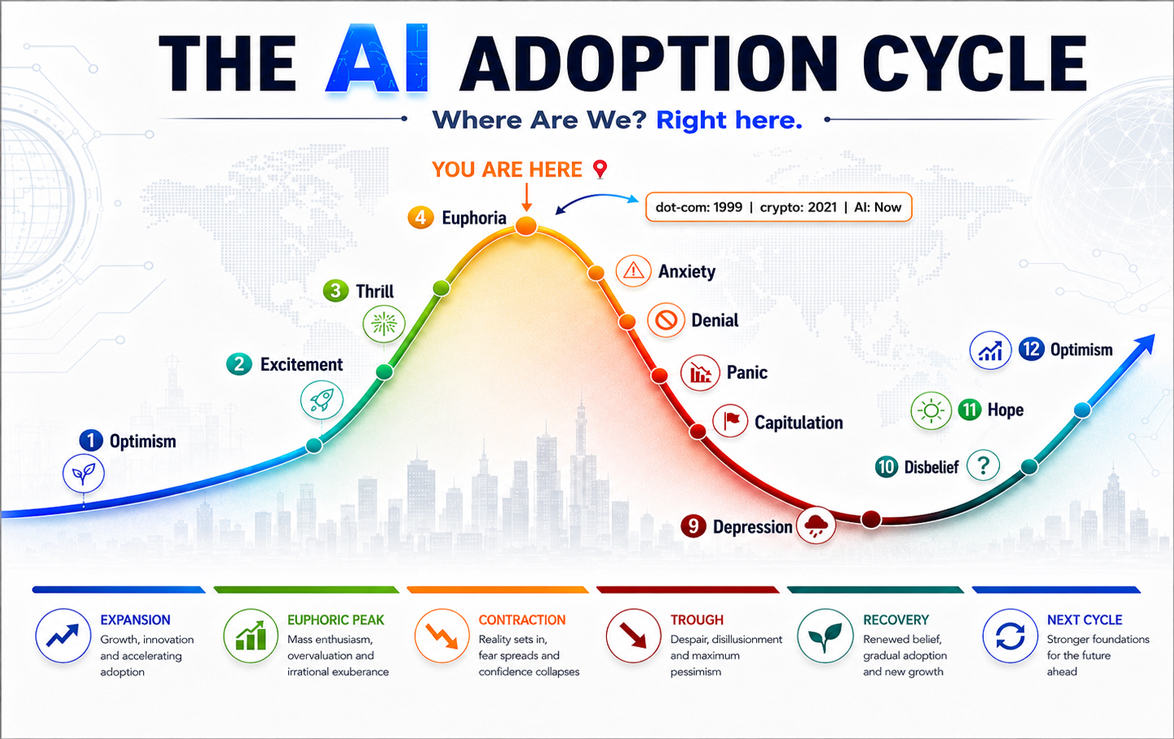
There’s a chart that’s been floating around trading desks and investor letters for decades. It’s called the Wall Street Cheat Sheet — the market psychology cycle. You’ve probably seen it. If you haven’t, picture a roller coaster drawn as a sine wave with names attached to each peak and valley.

It goes like this: Optimism → Excitement → Thrill → Euphoria → Anxiety → Denial → Panic → Capitulation → Depression → Disbelief → Hope → Optimism. And then it does it all over again. Forever.
The chart isn’t a prediction. It’s a mirror. Every bubble in human history — tulips, railroads, dot-com, housing, crypto — rode this exact track. Different decade, different “this time it’s different” story, same cycle. Because the asset changes but the people don’t. We’re still apes who get excited when the line goes up and panic when it goes down.
So the question isn’t whether the cycle applies to AI. The cycle always applies. The question is: where on the chart are we right now?
I’ll tell you where we are. We’re in Euphoria. We’re standing at the top of the roller coaster, hands in the air, screaming with delight, and we have not yet noticed that the track ahead is going down.
Look around. Every product launch has “AI-powered” stapled to the front of it like a participation ribbon. Your toaster is getting a copilot. Apple is rebuilding Siri from the studs because they got caught flat-footed. Nvidia is one of the most valuable companies on Earth — a chip company most of you couldn’t have picked out of a lineup five years ago. Microsoft and Google are spending tens of billions a quarter on data centers like it’s a Cold War arms race. ChatGPT has hundreds of millions of weekly users. There are AI startups with no revenue and no product getting valuations that would have made a dot-com CFO blush.
And here’s the tell that most people aren’t talking about: token pricing. Right now, the companies selling access to these AI models — OpenAI, Anthropic, Grok, Google — are charging pretty much whatever they want, and developers are paying it. Because they have to. If you’re building a product in 2025 and you’re not AI-powered, you’re already behind. So you pay the toll. Startups are building entire businesses on top of these APIs, baking the cost into their margins and hoping the math works out. The model providers are at peak pricing power — sitting at the top of the curve, collecting the euphoria tax.
This always happens at the peak. The infrastructure layer — the picks-and-shovels play — makes money hand over fist while everyone else is scrambling to stake their claim. It happened with internet bandwidth in ’99. It happened with cloud computing fees in the early 2010s. Now it’s tokens. And just like before, when the roller coaster tips over the back side of that curve, the pricing will compress, margins will collapse, and a lot of those businesses built on expensive API calls will find out they weren’t really businesses at all. They were just riding the wave.
This is 1999. This is also 2021. The vibes are identical.
In 1999, my buddies were quitting good jobs to go work at companies whose business plan was “we put pet food on the internet.” Pets.com had a Super Bowl ad and a sock puppet and went to zero in nine months. eToys, Webvan, Kozmo — all gone. The Nasdaq lost 78% of its value from peak to trough. People who had paper millions had nothing.
In 2021, NFTs of monkeys were selling for the price of a house in Ohio. Crypto influencers were renting Lamborghinis to film TikToks. Everyone’s barber had a Coinbase account. Then 2022 came, FTX collapsed, and somewhere around $2 trillion in market cap evaporated like a puddle in July.
You know this story. You’ve lived it. Twice, at least.
So what comes next? Anyone who tells you they know exactly when the music stops is selling you something. But the cycle is the cycle. After Euphoria comes Anxiety. Then Denial. Then Panic. Then the long, ugly winter where everyone pretends they were never into it in the first place.
Here’s the part most people miss, though, and it’s the most important part: the companies that survive Euphoria are the ones that were actually building something real.
Amazon went from $107 a share in 1999 to $6 a share by 2001. Six bucks. People wrote obituaries. “Amazon.bomb.” Today it’s worth more than two trillion dollars. Why? Because Bezos was actually building infrastructure — warehouses, logistics, AWS — while everyone else was buying domain names and burning VC money on Aeron chairs. I even had my share of it. B-2-B’s were fully propped up with cash to burn, sorry to say that was somebody’s hard earned cash I was participating in. This company (that no longer exists) sent me to Doral, the Blue Monster. All expenses paid, coolers fully stocked, shanked my way around the course had the time of my life and logo golf balls to boot. Man what great memories.
Bitcoin crashed from $69,000 to $16,000. Crypto Twitter (I joined twitter in 2009) went silent. The “experts” declared it dead for the seventh time. Today it’s hovering around all-time highs again. Because underneath the casino floor of memecoins and rug pulls, there was an actual technology that actual people actually wanted.
The cycle doesn’t kill the good ideas. It just kills the bad ones. Which is, honestly, what it’s for.
Now here’s where I’m going to push back on my own argument a little, because I think this matters.
Every bubble has a “this time is different” story, and that story is almost always wrong. But almost is doing a lot of work in that sentence. Because once in a while, the underlying technology genuinely is transformative. The internet was. Smartphones were. And — this is the bet — AI is.
The hype is ahead of reality. That part is true. Half the “AI features” you’re being sold right now are autocomplete with a marketing budget. There will be a reckoning. Stock prices will get hammered. Some big names you currently respect will quietly turn out the lights.
But the technology itself? The ability for software to read, write, see, reason, and act on your behalf? That’s not vaporware. That’s not a sock puppet selling dog food. That’s a fundamental shift in what computers can do, and it’s already changing how work gets done in offices, labs, and farms — including this one.
The hype will deflate. The technology will keep going. Those are two different curves, and people who confuse them are going to get hurt either by panicking too early or believing too long.
So pay attention. Not because you need to day-trade Nvidia — you don’t, please don’t — but because we are watching one of those once-in-a-generation transitions in real time, and the people who understand what they’re seeing tend to come out the other side a lot better off than the people who didn’t.
You don’t have to be an investor to think like one. Notice what’s actually useful versus what’s a logo on a slide. Notice which companies are building infrastructure versus chasing a buzzword. Notice your own euphoria, and notice your own panic when it arrives — because it will arrive, and it will feel like the end of the world, and it won’t be.
The folks who understood the dot-com cycle in 2001 weren’t the ones who got rich in 1999. They were the ones who quietly bought Amazon at five bucks while everyone else was busy being scared.
That window is coming. Stay vigilant! Don’t blink.